In Homer’s Iliad he is described as of great stature, colossal frame and strongest of all the Achaeans. Known as the “bulwark of the Achaeans”,[2] he was trained by the centaur
Chiron (who had trained Ajax’ father Telamon and Achilles’ father Peleus and would later die of an accidental wound inflicted by Heracles, whom he was at the time training), at the same time as Achilles. He was described as vicious, fearless, strong and powerful but also with a very high level of combat intelligence.
After Achilles, Ajax is the most valuable warrior in Agamemnon‘s army (along with Diomedes), though he is not as cunning as Nestor, Diomedes, Idomeneus, or Odysseus, he is much more powerful and just as intelligent. He commands his army wielding a huge shield made of seven cow-hides with a layer of bronze. Most notably, Ajax is not wounded in any of the battles described in the Iliad, and he is the only principal character on either side who does not receive substantial assistance from any of the gods who take part in the battles, although, in book 13, Poseidon strikes Ajax with his staff, renewing his strength.
Trojan War
In the Iliad, Ajax is notable for his abundant strength and courage, seen particularly in two fights with Hector. In Book 7, Ajax is chosen by lot to meet Hector in a duel which lasts most of a whole day. Ajax at first gets the better of the encounter, wounding Hector with his spear and knocking him down with a large stone, but Hector fights on until the heralds, acting at the direction of Zeus, call a draw: the action ends without a winner and with the two combatants exchanging gifts, Ajax giving Hector a purple sash and Hector giving Ajax a sharp sword.
The second fight between Ajax and Hector occurs when the latter breaks into the Mycenaean camp, and fights with the Greeks among the ships. In Book 14, Ajax throws a giant rock at Hector which almost kills him. In Book 15, Hector is restored to his strength by Apollo and returns to attack the ships. Ajax, wielding an enormous spear as a weapon and leaping from ship to ship, holds off the Trojan armies virtually single-handedly. In Book 16, Hector and Ajax duel once again. Hector is set on burning the ships, the only way he feels the Greeks will truly be defeated. Hector is able to disarm Ajax (although Ajax is not hurt) and Ajax is forced to retreat, seeing that Zeus is clearly favoring Hector. Hector and the Trojans succeed in burning one Greek ship, the culmination of an assault that almost finishes the war. Ajax is responsible for the death of many Trojans lords, including Phorcys.
Ajax often fought in tandem with his brother Teucer, known for his skill with the bow. Ajax would wield his magnificent shield, as Teucer stood behind picking off enemy Trojans.
Achilles was absent during these encounters because of his feud with Agamemnon. In Book 9, Agamemnon and the other Mycenaean chiefs send Ajax, Odysseus and Phoenix to the tent of Achilles in an attempt to reconcile with the great warrior and induce him to return to the fight. Although Ajax speaks earnestly and is well received, he does not succeed in convincing Achilles.
When Patroclus is killed, Hector tries to steal his body. Ajax, assisted by Menelaus, succeeds in fighting off the Trojans and taking the body back with his chariot; however, the Trojans had already stripped Patroclus of Achilles’ armor. Ajax’s prayer to Zeus to remove the fog that has descended on the battle to allow them to fight or die in the light of day has become proverbial. According to Hyginus, in total, Ajax killed 28 people at Troy.[3]
Death
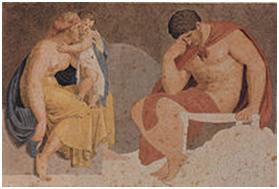

Sorrowful Ajax (Asmus Jacob Carstens, ca. 1791)

A Black-figure Amphora with Ajax Carrying the Dead Achilles. Walters Art Museum, Baltimore.
Like most of the other Greek leaders, Ajax is alive and well as the Iliad comes to a close. Later, when Achilles dies, killed by Paris (with help from Apollo), Ajax and Odysseus are the heroes who fight against the Trojans to get the body and bury it next to his cousin, Patroclus. Ajax, with his great shield and spear, manages to drive off the Trojans, while Odysseus pulls the body to his chariot, and rides away with it to safety. After the burial, both claim the armor for themselves, as recognition for their efforts. After several days of competition, Odysseus and Ajax are tied for the ownership of the magical armor which was forged on Mount Olympus by the god Hephaestus. It is then that a competition is held to determine who deserves the armor. Ajax argues that because of his strength and the fighting he has done for the Greeks, including saving the ships from Hector, and driving him off with a massive rock, he deserves the armor.[4] However, Odysseus proves to be more eloquent, and the council gives him the armor. Ajax, “Unconquered”, and furious, falls upon his own sword, “conquered by his [own] sorrow”.[5]
In Sophocles’ play Ajax, a famous retelling of Ajax’s demise takes place—after the armor is awarded to Odysseus the hero Ajax falls to the ground, exhausted. When he wakes up, he is under the influence of a spell from Athena. He goes to a flock of sheep and slaughters them, imagining they are the Achaean leaders, including Odysseus and Agamemnon. When he comes to his senses, covered in blood, and realizes that what he has done has diminished his honor, and he decides that he prefers to kill himself rather than live in shame. He does so with the same sword Hector gave him when they exchanged presents.[6] From his blood sprang a red flower, as at the death of Hyacinthus, which bore on its leaves the initial letters of his name Ai, also expressive of lament.[7] His ashes were deposited in a golden urn on the Rhoetean promontory at the entrance of the Hellespont.
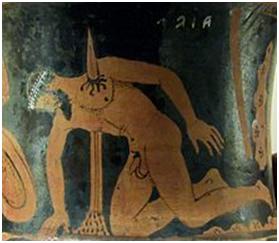

The suicide of Ajax
Homer is somewhat vague about the precise manner of Ajax’s death but does ascribe it to his loss in the dispute over Achilles’ shield; when Odysseus visits Hades, he begs the soul of Ajax to speak to him, but Ajax, still resentful over the old quarrel, refuses and descends silently back into Erebus.
Like Achilles, he is represented (although not by Homer) as living after his death in the island of Leuke at the mouth of the Danube.[8] Ajax, who in the post-Homeric legend is described as the grandson of Aeacus and the great-grandson of Zeus, was the tutelary hero of the island of Salamis, where he had a temple and an image, and where a festival called Aianteia was celebrated in his honour.[9] At this festival a couch was set up, on which the panoply of the hero was placed, a practice which recalls the Roman Lectisternium. The identification of Ajax with the family of Aeacus was chiefly a matter which concerned the Athenians, after Salamis had come into their possession, on which occasion Solon is said to have inserted a line in the Iliad (2.557–558), for the purpose of supporting the Athenian claim to the island. Ajax then became an Attic hero; he was worshiped at Athens, where he had a statue in the market-place, and the tribe Aiantis was named after him. Pausanias also relates that a gigantic skeleton, its kneecap 5 inches (13 cm) in diameter, appeared on the beach near Sigeion, on the Trojan coast; these bones were identified as those of Ajax.
Palace
In 2001, Yannos Lolos began excavating a Mycenaean palace on the island of Salamis which he supposed to be the home of the mythological Aiacid dynasty. The ruins have been excavated at a site near the village of Kanakia of Salamis, a few miles off the coast of Athens. The multi-story structure covers 750 m2 (8,100 sq ft) and had perhaps 30 rooms. The Trojan War is supposed by many[who?] to have occurred at the height of the Mycenaean civilization (see discussion of Troy VII), roughly the point at which this palace appears to have been abandoned.[10]
See also
References


 JOHN RUBENS is no Mother Teresa.